Ladle handling electric overhead travelling (EOT) crane, handling of liquid steel ladles in a steel melt shop, in continuous production from the electric arc furnace (EAF) to the ladle furnace (LF), from the ladle furnace (LF) to the vacuum degassing (VD) unit, and from the vacuum degassing (VD) unit to the continuous casting machine.

Ladle handling electric overhead travelling (EOT) crane
How to Choose a Manufacturer of Ladle Handling Electric Overhead Travelling (EOT) Crane
When selecting a manufacturer for electric overhead traveling cranes used for ladle handling, one should not focus solely on equipment price. Instead, it is essential to prioritize the manufacturer’s experience with metallurgical operating conditions, safety design for ladle transport, the reliability of critical components, their track record of past projects, and their capacity to provide full-lifecycle support.
1. Specialized Experience in Manufacturing Metallurgical Cranes
Prioritize manufacturers with proven experience in producing ladle cranes, casting cranes, or other types of metallurgical cranes designed for high-temperature, heavy-duty operations.
- Do they have a track record of delivering similar equipment with comparable tonnage?
- Can they provide project photographs, technical documentation, and verifiable client references?
- Do they demonstrate an understanding of the actual operational processes within a steel mill?
2. Hoisting Systems and Safety Protection
The core requirement for ladle handling is the reliable support and control of the ladle. Evaluate the main hoisting mechanism, braking systems, wire ropes, drums, pulley blocks, hooks or lifting attachments, and the associated safety protection schemes.
- Are there redundant or fail-safe designs for critical hoisting functions?
- Are there appropriate protective features in place, such as overload protection, limit switches, and brake monitoring?
- Is there documented support for the selection, engineering calculations, and inspection of critical components?
3. Adaptation to High-Temperature Environments
Assess the provisions for thermal insulation, heat resistance for motors and electrical equipment, lubrication systems, and cable routing, based on the ladle’s travel path, the intensity of thermal radiation, and the specific site environment.
4. Manufacturing Capabilities and Quality Control
Examine the manufacturer’s capabilities regarding structural steel welding, non-destructive testing (NDT), mechanical machining, assembly, factory acceptance testing (FAT), and quality traceability. Ensure the manufacturer can provide relevant inspection records, material certifications, and test reports.
5. Automation and Control Systems
Evaluate features such as variable-frequency drive (VFD) speed control, hoisting synchronization, positioning, anti-sway systems, condition monitoring, fault diagnostics, and remote maintenance capabilities—all based on specific operational requirements. Automation configurations should be driven by process and safety needs, rather than simply maximizing the number of features.
6. Project Delivery and On-Site Services
Confirm the scope of the manufacturer’s responsibilities, including design, fabrication, transportation, installation supervision, commissioning, training, and final acceptance. Clearly define the division of responsibilities, project timelines, spare parts availability, and after-sales support mechanisms.
7. Total Life-Cycle Cost
Do not base your decision solely on the initial purchase price. Consider factors such as energy consumption, the cost of critical spare parts, maintenance frequency, potential losses due to downtime, ease of servicing, and the expected service life of the equipment.
Why Choose Ladle Handling Electric overhead cranes Manufactured by Weihua
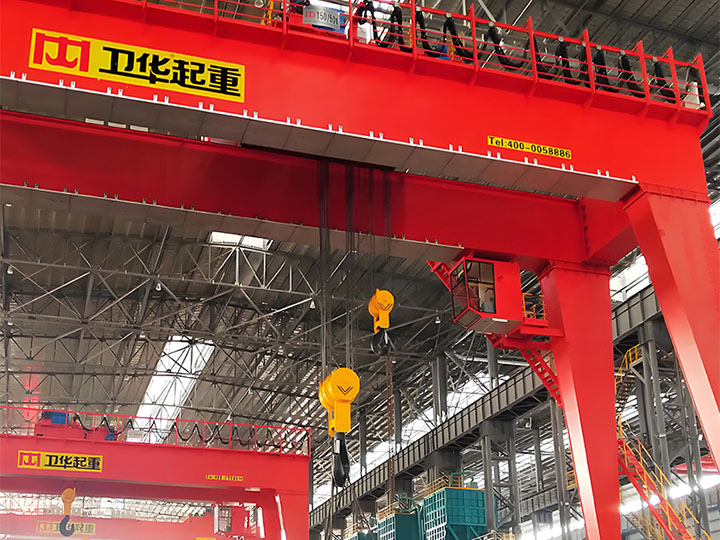
The primary reason for choosing a Weihua-manufactured electric overhead traveling crane for ladle handling is that Weihua Group—ranked first in China and second globally among crane manufacturers—possesses a proven track record of recent deliveries for high-tonnage metallurgical cranes. Weihua Group offers mature, safety-focused designs specifically for ladle transport, as well as equipment with environmental adaptability verified under extreme operating conditions. For heavy-duty metallurgical applications, Weihua provides more specialized, industry-specific engineering evidence than manufacturers of general-purpose cranes.

Weihua-manufactured electric overhead traveling crane for ladle handling
5 Key Advantages of Weihua Ladle Cranes
1. Extensive Experience in Manufacturing Metallurgical Cranes
Weihua’s range of metallurgical cranes covers applications such as ladle handling, charging, forging, quenching, and the transport of steel plates and billets, offering a comprehensive product portfolio tailored to the specific demands of the iron and steel industry.
2. Safety-Focused Design for Molten Metal Handling
Depending on project specifications, safety features—such as independent wire rope reeving systems, dual braking, overspeed monitoring, overload protection, and limit switches—can be incorporated to enhance safety during critical lifting operations. (Specific configurations are subject to the project’s technical proposal.)
3. Designed for High-Temperature, Dusty Environments
To ensure reliable performance in the demanding conditions of a steelmaking workshop, cranes can be equipped with thermal insulation, cooling systems for electrical components, high-temperature-resistant motors, and specialized dust-protection measures.
4. Customized Design Based on Operational Requirements
Rather than relying on standardized, off-the-shelf bridge crane configurations, Weihua develops bespoke solutions tailored to factors such as rated capacity, span, lifting height, duty class, available headroom, and the specific layout of the facility.
5. Comprehensive Support: From Delivery to Long-Term Maintenance
Weihua provides end-to-end support, including solution design, installation and commissioning, personnel training, spare parts supply, and ongoing maintenance services.