Steel plants are one of the industrial fields with the most intensive use of cranes, the most complex working conditions, and the most stringent requirements. According to the process flow and functions, the cranes used in steel plants can be mainly divided into the following categories:
1.Raw material handling and ironmaking area
used for unloading, stacking and feeding bulk materials such as ore, coal, limestone, etc.
Electromagnetic bridge crane:
equipped with electromagnetic chuck, used to transport scrap steel, pig iron and other magnetically conductive raw materials.
2.Steelmaking and refining areas (core hazard areas)
Molten iron mixing crane:
transport the molten iron tank from the blast furnace to the converter and dump it into the converter.
Feeding crane:
Lift the scrap steel basket to the top of the electric furnace or converter for feeding. Most of them have a double-car structure, and the heat radiation in front of the furnace is large.
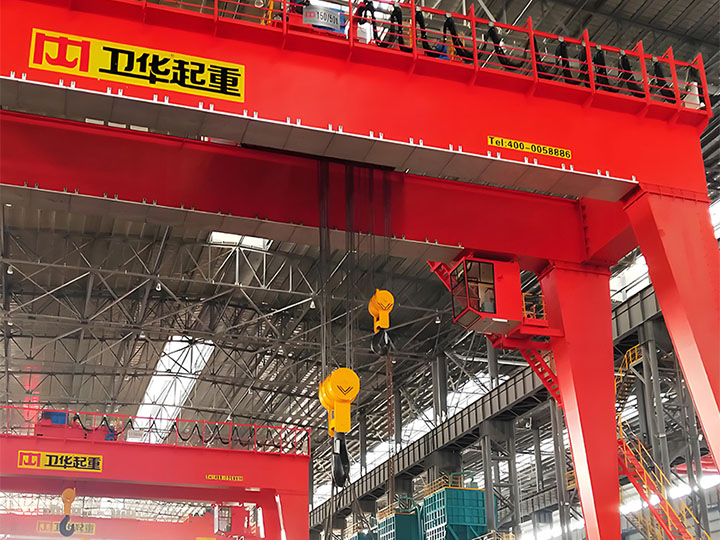
Also known as a casting crane or molten metal crane. This is the crane with the highest safety level and the most complex technology in the entire plant.
Function: After tapping steel from the converter/electric furnace, it is responsible for lifting ladles filled with high-temperature liquid steel, transporting them across workshops, participating in refining (such as LF furnace, RH furnace) and continuous casting.
Features: Double beams, double trolleys, four main beams, and four track structures, with extremely high stability; the main lifting mechanism adopts dual drives, dual braking systems, or even four drives. If one set fails, the other can complete the work independently and safely; equipped with complete heat insulation protection, electronic anti-sway, and millimeter-level precise positioning systems.
Auxiliary hook crane:
cooperates with the main crane to complete tasks such as tilting the furnace body, repairing the furnace, and lifting auxiliary items.
3.Continuous Casting and Rolling Area
Slab/Billet Clamp Crane:
Function: To transport high-temperature or cooled steel billets produced from the continuous casting machine.
Features: Using hydraulic or lever clamps, multiple pieces can be clamped at one time with high efficiency. It is the main force in the continuous casting back area and hot rolling raw material warehouse.
Electromagnetic disk crane:
used to transport steel plate coils, bundles of wire rods, profiles and other finished products. Fast loading and unloading.
Ingot removal crane:
used in the old mold casting process to force the solidified steel ingot out of the ingot mold.
4.Finished product warehouse and shipping area
transporting finished steel products.
handling steel, H-shaped steel, steel pipes, etc.
Crane with C-shaped hook:
specially used to lift steel coils horizontally to prevent damage to the coils.
Common core features and requirements for steel plant cranes
1.High working level: Very frequent use (A7, A8 level), nearly 24 hours of continuous operation.
2.Extreme environment: faced with high temperature, high dust, high humidity, and metal splashing.
3.Heavy load and impact: It often works at full load and bears huge impact loads when feeding and dumping.
4.Ultra-high safety redundancy: Especially cranes that lift molten metal must comply with the most stringent safety standards (such as China's JB/T 7688.15, the EU's FEM standard) and adopt multiple protection designs.
5.Advanced control system: Fully variable frequency speed regulation is commonly used to achieve smooth starting and braking; an anti-sway system and a precise positioning system (±1mm level) must be equipped to ensure the connection between production safety and automation.
As China's leading supplier of steel plant cranes, Weihua Group's technical team can go deep into customer sites, understand the entire logistics and process pain points from "blast furnace tapping" to "rolling into finished products", and provide customized spreader solutions, workshop layout optimization suggestions and even overall lifting solutions. The steel mill cranes produced by Weihua can help customers minimize safety risks, maximize production efficiency, and optimize operating costs.